Polish PridePOLSKA. Z BLISKA.
/
Official anthem resources ↗Song of the Flag · living painting ↗
HISTORY ON CANVAS

A nation’s history.
An artist’s vision.

Polish history documented by brushes of Jan Matejko

From the beginnings of the Polish state to the struggles for its survival. Explore Jan Matejko’s major historical canvases and the complete twelve-part History of Civilisation in Poland cycle.

New: Song of the Flag · living canvas ↓Continue the story from 1918 Follow the story
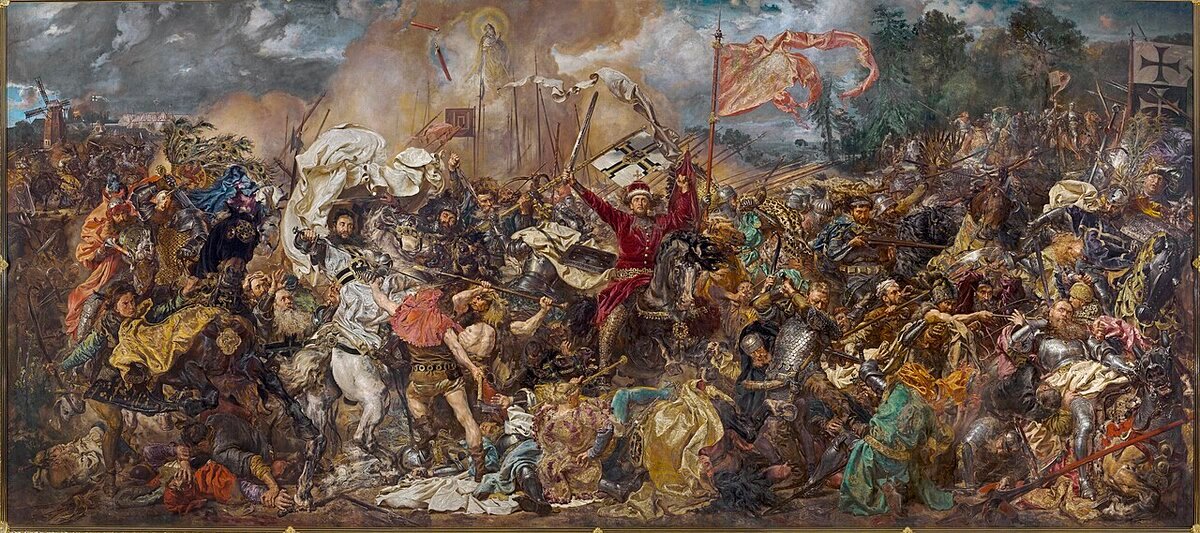
Jan Matejko, Battle of Grunwald
JAN MATEJKO · 1838–1893Battle of Grunwald, 1878 · reproduction: National Museum in Warsaw
✳

History, interpreted. These nineteenth-century paintings are artistic interpretations, often combining events, people and symbols. A painting’s title date may differ from today’s historical chronology; such differences are noted below.

THE PAINTED CHRONICLE

Poland, through the centuries.

38 documented paintingsDimensions: height × width, in centimetres.
38 / 38
966HISTORICAL EVENT01

Digital reproduction: National Museum in Warsaw. Individual photographer not identified in the Commons source metadata. · Public domain ↗

HISTORY OF CIVILISATION IN POLAND

Adoption of Christianity. AD 965

Matejko links the conversion of Mieszko I and the beginnings of the Christian Polish state with European religious and cultural networks. The crowded scene assembles symbolic figures and actions rather than documenting a witnessed baptism.

The artist’s title gives 965; the conventional historical date of Mieszko I’s baptism is 966.

National Museum in Warsaw · 19th-Century Art GalleryCollection location; consult the museum before visiting to confirm display and access.
1000HISTORICAL EVENT02

Digital reproduction: National Museum in Warsaw. Individual photographer not identified in the Commons source metadata. · Public domain ↗

HISTORY OF CIVILISATION IN POLAND

Coronation of the First King. AD 1001

The composition refers to Emperor Otto III’s meeting with Bolesław Chrobry at Gniezno and the recognition of the Piast ruler’s position in Christian Europe. Matejko represents a symbolic crowning, not the later royal coronation.

The Congress of Gniezno took place in 1000; Bolesław’s formal royal coronation was in 1025. The painting’s title uses 1001.

National Museum in Warsaw · 19th-Century Art GalleryCollection location; consult the museum before visiting to confirm display and access.
1018HISTORICAL EVENT03

Digital reproduction/source: This file comes from The National Museum in Kraków Digital Collection and is available under the digital ID [1]. Individual photographer not identified in this file record. · Public domain ↗

Bolesław the Brave and Sviatopolk at the Golden Gate in Kyiv

Bolesław’s 1018 expedition restored his son-in-law Sviatopolk to power in Kyiv. The picture uses the later legend of striking the Golden Gate with a sword; its architecture and regalia are not a literal record of 1018.

Deposit record MNK ND-11610; ownership and current public display require confirmation.

National Museum in Kraków, deposit record MNK ND-11610Holding collection or deposit is identified; consult the institution for current display and visiting access.
1096HISTORICAL EVENT04

Digital reproduction: National Museum in Warsaw. Individual photographer not identified in the Commons source metadata. · Public domain ↗

HISTORY OF CIVILISATION IN POLAND

Reception of the Jews

Matejko imagines Jewish refugees being received in Poland in the era of the First Crusade, against the background of Duke Władysław Herman’s court. The image reflects the artist’s vision of asylum and cultural coexistence, rather than proof of one documented reception ceremony.

This is the small cycle painting in the National Museum in Warsaw, not the larger separate version held in Lublin.

National Museum in Warsaw · 19th-Century Art GalleryCollection location; consult the museum before visiting to confirm display and access.
1180HISTORICAL EVENT05

Digital reproduction: National Museum in Warsaw. Individual photographer not identified in the Commons source metadata. · Public domain ↗

HISTORY OF CIVILISATION IN POLAND

The First Assembly at Łęczyca. Codification of Laws. Suppression of Robbery

The painting associates Casimir II the Just’s assembly with law, political negotiation and the ordering of society during Poland’s period of regional fragmentation. Its theatrical gathering should not be mistaken for a modern elected parliament.

The historical assembly is dated to 1180; Matejko’s title gives 1182.

National Museum in Warsaw · 19th-Century Art GalleryCollection location; consult the museum before visiting to confirm display and access.
1241HISTORICAL EVENT06

Digital reproduction: National Museum in Warsaw. Individual photographer not identified in the Commons source metadata. · Public domain ↗

HISTORY OF CIVILISATION IN POLAND

Defeat at Legnica — Rebirth

The death of Henry II the Pious in the Mongol invasion of 1241 becomes a meditation on collective catastrophe and renewal. Rather than the battle itself, Matejko focuses on mourning and the rebuilding of communal life.

An allegorical aftermath, not a literal reconstruction of the fighting.

National Museum in Warsaw · 19th-Century Art GalleryCollection location; consult the museum before visiting to confirm display and access.
1296HISTORICAL EVENT07

Digital reproduction/source: www.fakt.pl. Individual photographer not identified in this file record. · Public domain ↗

Death of King Przemysł II

King Przemysł II was killed at Rogoźno on 8 February 1296, shortly after his coronation had revived the Polish kingship. Matejko turns the assassination into a scene of violent resistance.

Published records differ: the article dates the work 1875 but one photo caption says 1878; measurements also vary slightly.

National Museum of Modern Art, ZagrebHolding collection or deposit is identified; consult the institution for current display and visiting access.
1364HISTORICAL EVENT08

Digital reproduction: National Museum in Warsaw. Individual photographer not identified in the Commons source metadata. · Public domain ↗

HISTORY OF CIVILISATION IN POLAND

Founding of the Academy, Consolidated by Its Transfer to Kraków

The composition combines the university foundation associated with Casimir the Great and its renewal under Jadwiga and Władysław Jagiełło. It brings patrons and generations together to celebrate the lasting role of higher learning.

The university’s founding charter dates to 1364 and its renewal to 1400; the painting’s title preserves Matejko’s different date sequence. Sorted here by 1364, the first securely dated historical foundation.

National Museum in Warsaw · 19th-Century Art GalleryCollection location; consult the museum before visiting to confirm display and access.
1366HISTORICAL EVENT09

Digital reproduction: National Museum in Warsaw. Individual photographer not identified in the Commons source metadata. · Public domain ↗

HISTORY OF CIVILISATION IN POLAND

Retaking of Ruthenia — Wealth and Education

The scene relates Casimir the Great’s eastward expansion to commerce, settlement and learning. Its personifications of prosperity and education reveal Matejko’s interpretation of state-building rather than an objective record of a single gathering.

The language of the historical title reflects the artist’s nineteenth-century viewpoint.

National Museum in Warsaw · 19th-Century Art GalleryCollection location; consult the museum before visiting to confirm display and access.
1387HISTORICAL EVENT10

Digital reproduction: National Museum in Warsaw. Individual photographer not identified in the Commons source metadata. · Public domain ↗

HISTORY OF CIVILISATION IN POLAND

Baptism of Lithuania

The conversion of Lithuania under Władysław Jagiełło forms a major chapter in the growing Polish–Lithuanian connection. Matejko gathers rulers, clergy and people into a ceremonial synthesis of religious and political transformation.

The symbolic gathering condenses a longer process; not all depicted figures need have attended one ceremony.

National Museum in Warsaw · 19th-Century Art GalleryCollection location; consult the museum before visiting to confirm display and access.
1400HISTORICAL EVENT11

Digital reproduction: National Museum in Warsaw. Individual photographer not identified in the Commons source metadata. · Public domain ↗

HISTORY OF CIVILISATION IN POLAND

The University’s Influence on the Country — Hussitism and Humanism

The university becomes a centre through which scholarship, humanism and religious debate circulate in fifteenth-century Poland. The assembly of scholars and cultural figures is a retrospective panorama, not one dated meeting.

No single event date is asserted; for chronology this century-wide allegory is placed at the start of the fifteenth century.

National Museum in Warsaw · 19th-Century Art GalleryCollection location; consult the museum before visiting to confirm display and access.
1410HISTORICAL EVENT12

Digital reproduction/source: National Museum in Warsaw. Individual photographer not identified in this file record. · Public domain ↗

Battle of Grunwald

The Polish–Lithuanian army defeated the Teutonic Order on 15 July 1410. The composition concentrates on Vytautas and the death of Grand Master Ulrich von Jungingen, combining historical people with symbolic and legendary details.

National Museum in WarsawHolding collection or deposit is identified; consult the institution for current display and visiting access.
1425HISTORICAL EVENT13

Digital reproduction/source: National Museum in Warsaw. Individual photographer not identified in this file record. · Public domain ↗

Baptism of Władysław Warneńczyk, 18 February 1425

The baptism of the future Władysław III celebrated the continuation of the Jagiellonian dynasty. He later ruled Poland and Hungary and died at Varna in 1444. The ceremony is reconstructed through Matejko’s nineteenth-century imagination.

National Museum in WarsawHolding collection or deposit is identified; consult the institution for current display and visiting access.
1444HISTORICAL EVENT14

Digital reproduction/source: http://www.kepido.oszk.hu/attachments/images/nagy/mn 4056t.jpg. Individual photographer not identified in this file record. · Public domain ↗

Battle of Varna

Władysław III, king of Poland and Hungary, was killed fighting Ottoman forces at Varna on 10 November 1444. Matejko makes the young king’s charge the focus of a tragic military episode.

Official Hungarian catalogue gives 58 × 91 cm; some Commons files report 92 cm width.

Hungarian National Gallery, Budapest; inventory 102.BThe museum’s catalogue currently lists the painting as not on display; consult the institution for updates.
1500HISTORICAL EVENT15

Digital reproduction/source: www.pinakoteka.zascianek.pl muzea.malopolska.pl. Individual photographer not identified in this file record. · Public domain ↗

Astronomer Copernicus, or Conversations with God

Copernicus appears on a rooftop at Frombork contemplating a heliocentric cosmos. This is a symbolic vision of sixteenth-century scientific thought, not a dated observation; the painting was completed for the four-hundredth anniversary of his birth.

The scene has no exact historical date; published measurements give a height of 225–226 cm.

Jagiellonian University, Collegium Novum, KrakówHolding collection or deposit is identified; consult the institution for current display and visiting access.
1500HISTORICAL EVENT16

Digital reproduction: National Museum in Warsaw. Individual photographer not identified in the Commons source metadata. · Public domain ↗

HISTORY OF CIVILISATION IN POLAND

The Golden Age of Literature — Reformation and the Predominance of Catholicism

Matejko presents Renaissance culture as a meeting of literature, learning and competing religious ideas. Figures from different moments of the sixteenth century share the same symbolic space.

No single event date is asserted; sorted by the beginning of the sixteenth century. The available museum reproduction is 800 × 533 pixels.

National Museum in Warsaw · 19th-Century Art GalleryCollection location; consult the museum before visiting to confirm display and access.
1514HISTORICAL EVENT17

Digital reproduction/source: This file was uploaded to Wikimedia Commons as part of a GLAM-WIKI partnership project between the National Museum in Warsaw and Wikimedia Polska.. Individual photographer not identified in this file record. · Public domain ↗

Stańczyk

The court jester broods over the loss of Smolensk to Muscovy in 1514 while a court ball continues behind him. Matejko combines different times and figures to contrast political foresight with complacency rather than reproduce one literal evening.

National Museum in WarsawHolding collection or deposit is identified; consult the institution for current display and visiting access.
1519HISTORICAL EVENT18

Digital reproduction/source: mnp.art.pl mnp.art.pl. Individual photographer not identified in this file record. · Public domain ↗

Founding of the Lubrański Academy in Poznań

Bishop Jan Lubrański founded the academy in Poznań in 1519. Painted under Prussian rule, the scene recalls the region’s educational traditions; Matejko freely adapts local architecture and includes the nineteenth-century commissioner’s likeness.

National Museum in PoznańHolding collection or deposit is identified; consult the institution for current display and visiting access.
1521HISTORICAL EVENT19

Digital reproduction/source: http://cyfrowe.mnw.art.pl/dmuseion/docmetadata?id=4798. Individual photographer not identified in this file record. · Public domain ↗

Hanging of the Sigismund Bell in Kraków in 1521

The installation of the Sigismund Bell at Wawel in 1521 becomes a celebration of Poland’s Renaissance. Matejko includes people who could not all have attended, using the ceremony as a symbolic panorama of the age.

National Museum in WarsawHolding collection or deposit is identified; consult the institution for current display and visiting access.
1525HISTORICAL EVENT20

Digital reproduction/source: www.pinakoteka.zascianek.pl. Individual photographer not identified in this file record. · Public domain ↗

The Prussian Homage

On 10 April 1525, Duke Albrecht Hohenzollern paid homage to Sigismund I in Kraków after the secularisation of the Teutonic state in Prussia. The reflective Stańczyk and later architecture turn triumph into a meditation on the future.

Use official MNK dimensions 388 × 785 cm; some older secondary sources and Commons wikitext incorrectly report 875 cm width.

MNK Sukiennice, Kraków; Wawel collection on depositHolding collection or deposit is identified; consult the institution for current display and visiting access.
1547HISTORICAL EVENT21

Digital reproduction/source: This file comes from The National Museum in Kraków Digital Collection and is available under the digital ID 21723. Individual photographer not identified in this file record. · Public domain ↗

Sigismund Augustus and Barbara Radziwiłł

The picture imagines an intimate meeting between Sigismund Augustus and Barbara in Vilnius. Their secret marriage in 1547 and opposition to the union made their relationship a subject of dynastic and political history.

Jan Matejko House, National Museum in KrakówHolding collection or deposit is identified; consult the institution for current display and visiting access.
1569HISTORICAL EVENT22

Digital reproduction/source: https://eregwen.livejournal.com/1144123.html. Individual photographer not identified in this file record. · Public domain ↗

Union of Lublin

The Union of Lublin of 1569 created the Polish–Lithuanian Commonwealth. Sigismund Augustus holds a crucifix above an oath-taking ceremony, while the many assembled figures give the constitutional union a dramatic, symbolic form.

National Museum in Lublin; National Museum in Warsaw depositHolding collection or deposit is identified; consult the institution for current display and visiting access.
1572HISTORICAL EVENT23

Digital reproduction/source: National Museum in Warsaw. Individual photographer not identified in this file record. · Public domain ↗

Death of Sigismund Augustus at Knyszyn in 1572

The death of Sigismund II Augustus on 7 July 1572 ended the male Jagiellonian line and led to the Commonwealth’s first interregnum under the new electoral system. Matejko places human weakness and dynastic decline around the royal deathbed.

District Museum in Toruń; National Museum in Warsaw depositHolding collection or deposit is identified; consult the institution for current display and visiting access.
1573HISTORICAL EVENT24

Digital reproduction: National Museum in Warsaw. Individual photographer not identified in the Commons source metadata. · Public domain ↗

HISTORY OF CIVILISATION IN POLAND

The Commonwealth at the Zenith of Power — Golden Liberty — Election

The first royal election after the end of the Jagiellonian male line becomes Matejko’s image of the noble Commonwealth at its height. The celebrated political liberty belonged chiefly to the nobility, not equally to all inhabitants.

The scene is a political allegory of the elective system, not a neutral documentary view.

National Museum in Warsaw · 19th-Century Art GalleryCollection location; consult the museum before visiting to confirm display and access.
1581HISTORICAL EVENT25

Digital reproduction/source: https://kolekcja.zamek-krolewski.pl/obiekt/id/ZKW_1047. Individual photographer not identified in this file record. · Public domain ↗

Stephen Báthory at Pskov

Matejko combines embassies received during Báthory’s campaigns of 1579–1581 and the negotiations leading to the 1582 Truce of Jam Zapolski. Pskov itself was not captured: the scene is an allegorical synthesis of war and diplomacy.

Royal Castle in WarsawHolding collection or deposit is identified; consult the institution for current display and visiting access.
1588HISTORICAL EVENT26

Digital reproduction/source: http://www.pinakoteka.zascianek.pl/Matejko/Images/Zamoyski_pod_Byczyna_2_s.jpg. Individual photographer not identified in this file record. · Public domain ↗

Jan Zamoyski at Byczyna

After the Battle of Byczyna on 24 January 1588, Archduke Maximilian Habsburg surrendered to Jan Zamoyski, securing Sigismund III’s claim to the throne. The original canvas was lost in wartime; the image preserves the composition.

Original lost during the Second World War; associated with the Kozłówka collectionThe original cannot currently be visited. This is a historical reproduction; Kozłówka holds related copies.
1597HISTORICAL EVENT27

Digital reproduction/source: [1] www.zamek-krolewski.pl. Individual photographer not identified in this file record. · Public domain ↗

Skarga’s Sermon

Piotr Skarga’s Sejm Sermons, published in 1597, warned against divisions and abuses in the Commonwealth. Matejko invents an assembly across historical boundaries: this is not a documented delivery of one of those printed sermons.

Royal Castle in WarsawHolding collection or deposit is identified; consult the institution for current display and visiting access.
1600HISTORICAL EVENT28

Digital reproduction/source: pl.pinterest.com czytanieobrazow.pl. Individual photographer not identified in this file record. · Public domain ↗

Alchemist Sędziwój and King Sigismund III

Michał Sędziwój’s reputed alchemical demonstration at Sigismund III’s court presents the early-modern fascination with experimentation and transmutation. The scene follows an alchemical legend, not proof that gold was manufactured.

Herbst Palace Museum, Muzeum Sztuki in ŁódźHolding collection or deposit is identified; consult the institution for current display and visiting access.
1611HISTORICAL EVENT29

Digital reproduction/source: This file comes from The National Museum in Kraków Digital Collection and is available under the digital ID 14811. Individual photographer not identified in this file record. · Public domain ↗

The Shuysky Tsars at the Warsaw Sejm

On 29 October 1611, Hetman Stanisław Żółkiewski presented the captive former tsar Vasily Shuysky and his brothers before Sigismund III and the Sejm. This small late version is distinct from Matejko’s youthful 1853 treatment of the subject.

Jan Matejko House, National Museum in KrakówHolding collection or deposit is identified; consult the institution for current display and visiting access.
1648HISTORICAL EVENT30

Digital reproduction/source: http://cyfrowe.mnw.art.pl/dmuseion/docmetadata?id=4962. Individual photographer not identified in this file record. · Public domain ↗

Bohdan Khmelnytsky with Tugay Bey at Lviv

The Cossack leader Khmelnytsky and his Crimean Tatar ally appear during the 1648 siege of Lviv. The apparition of Saint John of Dukla introduces a religious legend into a scene connected with the uprising that transformed the Commonwealth.

National Museum in WarsawHolding collection or deposit is identified; consult the institution for current display and visiting access.
1656HISTORICAL EVENT31

Digital reproduction/source: gazeta.pl. Individual photographer not identified in this file record. · Public domain ↗

The Oath of King John Casimir

At Lviv Cathedral on 1 April 1656, during the Swedish invasion, John Casimir entrusted the Commonwealth to the Virgin Mary and promised reforms for the peasantry. Matejko’s final monumental canvas was left unfinished at his death.

National Museum in WrocławHolding collection or deposit is identified; consult the institution for current display and visiting access.
1683HISTORICAL EVENT32

Digital reproduction/source: https://quantaoflight.wordpress.com/2011/11/13/sobieski-pod-wiedniem/. Individual photographer not identified in this file record. · Public domain ↗

John III Sobieski at Vienna

The relief of Vienna on 12 September 1683 defeated the Ottoman besieging army. Matejko shows Sobieski sending news of victory to Pope Innocent XI, celebrating the Polish king’s role within the allied coalition rather than illustrating the cavalry charge itself.

Vatican Museums, Sobieski RoomHolding collection or deposit is identified; consult the institution for current display and visiting access.
1700HISTORICAL EVENT33

Digital reproduction/source: This file comes from The National Museum in Kraków Digital Collection and is available under the digital ID 372941. Individual photographer not identified in this file record. · Public domain ↗

Wernyhora

The legendary Ukrainian bard Wernyhora became associated with prophecies about Poland’s fall and renewal. Matejko’s vision belongs to the historical imagination of Polish–Ukrainian relations; it does not document a verifiable speech or a precise date.

MNK Sukiennice, KrakówHolding collection or deposit is identified; consult the institution for current display and visiting access.
1773HISTORICAL EVENT34

Photograph/reproduction: Maciej Szczepańczyk (Mathiasrex), via Wikimedia Commons. · Public domain ↗

Rejtan: The Fall of Poland

Tadeusz Rejtan opposed proceedings of the Partition Sejm in April 1773 after the First Partition. Matejko turns his protest into a moral accusation, gathering politicians and symbols that were not all present together in that moment.

Royal Castle in WarsawHolding collection or deposit is identified; consult the institution for current display and visiting access.
1791HISTORICAL EVENT35

Digital reproduction/source: www.zamek-krolewski.pl. Individual photographer not identified in this file record. · Public domain ↗

Constitution of 3 May 1791

The Constitution adopted on 3 May 1791 sought to reform the Commonwealth’s political system. The procession towards Saint John’s is a symbolic gathering: Matejko includes figures and social groups beyond the literal participants of that day.

Royal Castle in WarsawHolding collection or deposit is identified; consult the institution for current display and visiting access.
1794HISTORICAL EVENT36

Digital reproduction/source: This file comes from The National Museum in Kraków Digital Collection and is available under the digital ID 306743. Individual photographer not identified in this file record. · Public domain ↗

Kościuszko at Racławice

The victory at Racławice on 4 April 1794 became a symbol of the Kościuszko Uprising and the participation of peasant scythemen. Matejko focuses on Kościuszko and Bartosz Głowacki, giving the episode social and patriotic meaning beyond its limited strategic impact.

MNK Sukiennice, KrakówHolding collection or deposit is identified; consult the institution for current display and visiting access.
1795HISTORICAL EVENT37

Digital reproduction: National Museum in Warsaw. Individual photographer not identified in the Commons source metadata. · Public domain ↗

HISTORY OF CIVILISATION IN POLAND

Constitution of 3 May — Four-Year Sejm — Commission of Education — Partition

The closing image combines educational reform, the Four-Year Sejm and the Constitution of 3 May with the tragedy of the partitions. It places reformers from several decades together, making cultural achievement coexist with the loss of statehood.

The title’s 1795 marks the final partition; the Constitution was adopted in 1791 and the Commission of National Education founded in 1773. This 1888 cycle sketch is distinct from Matejko’s large Constitution painting of 1891.

National Museum in Warsaw · 19th-Century Art GalleryCollection location; consult the museum before visiting to confirm display and access.
1863HISTORICAL EVENT38

Digital reproduction/source: This file comes from The National Museum in Kraków Digital Collection and is available under the digital ID 325087. Individual photographer not identified in this file record. · Public domain ↗

Polonia: The Year 1863 (Poland Enchained)

An unfinished allegory of the January Uprising and repression: a woman personifying Poland is put in chains. The surrounding figures evoke the suffering and divided fortunes of the former Commonwealth rather than a single recorded incident.

Princes Czartoryski Museum, National Museum in KrakówHolding collection or deposit is identified; consult the institution for current display and visiting access.

Reading the collection

This is a documented collection of historically significant scenes, including the entire twelve-painting cycle, rather than a catalogue of every portrait, drawing or study Matejko produced. Museum records take priority when dimensions conflict. “Where to see it” identifies the holding collection; loans, conservation and display changes can affect access.

Jan Matejko is credited as the painter. Image credits identify the photographer or supplying institution only where the source names them; an unidentified photographer is marked explicitly. Thumbnails are resized, with the full composition retained; the viewer links to the original digital reproduction.

POETRY · REMEMBRANCE · A LIVING PAINTING

Pieśń o fladze — towards the clouds.

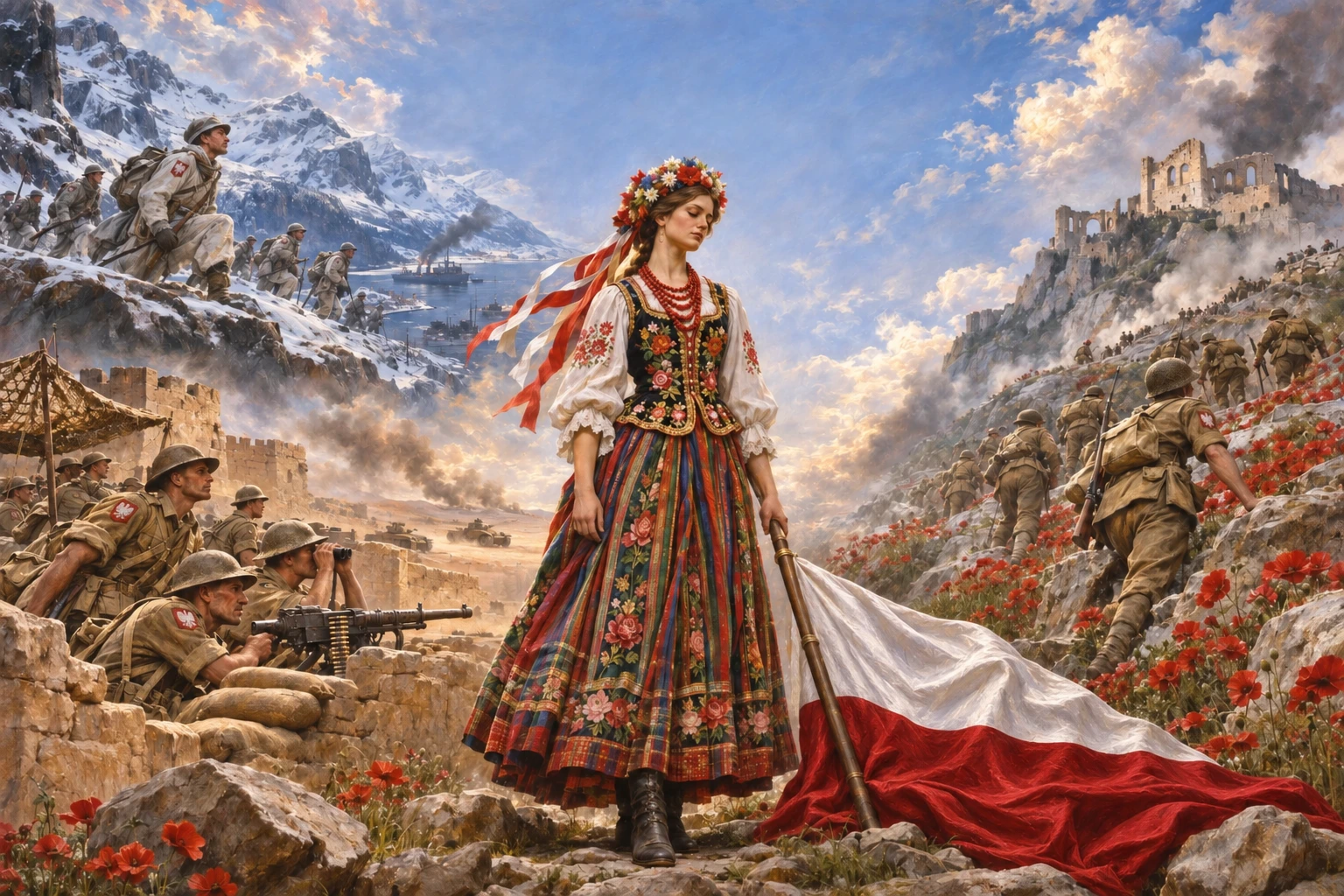
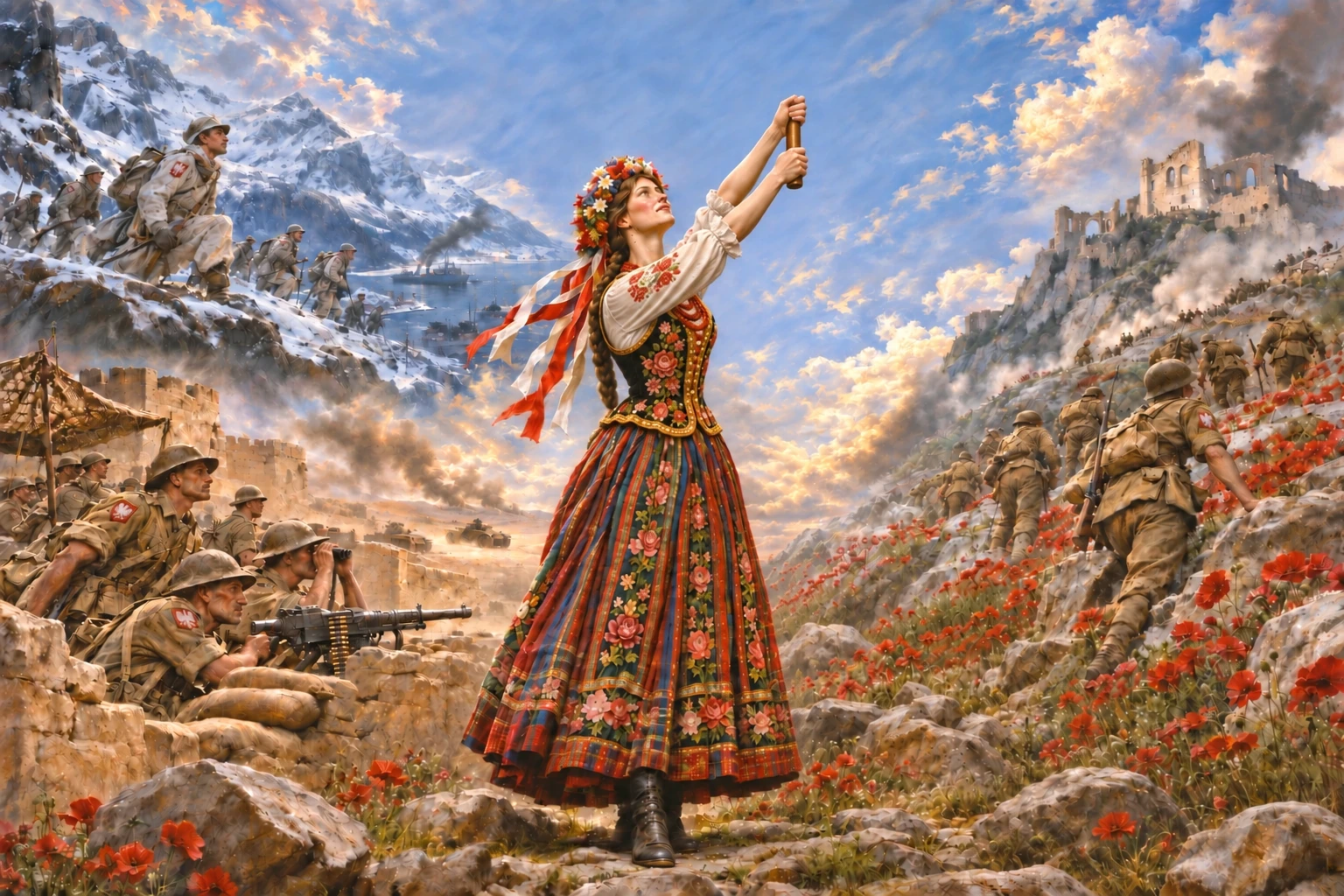
One white-and-red flag, three battlefields. Our allegory brings together Polish heroism at Narvik (1940), Tobruk (1941) and Monte Cassino (1944). A girl in Krakow folk costume stands at its heart, symbolising cultural endurance and hope. The costume is our artistic choice; the poem does not specify it.

Allegory of Polish soldiers at Tobruk, Narvik and Monte Cassino, with a girl in Krakow costume and a flag on the ground at the centre.
Original AI artwork: ChatGPT / OpenAI · Concept: Roman Muszynski · Inspired by Jan Matejko. An allegory, rather than a reconstruction of one battle.
A moment of reflection · flag rises in 60 sEnlarge painting ↗

Konstanty Ildefons Gałczyński · 1944

Ale wtedy przyszła dziewczyna
i uniosła flagę wysoko,
hej, wysoko, ku samym obłokom!

A short excerpt from “Song of the Flag”. Written in German captivity at Altengrabow in 1944, the poem gives voices to flags from different fronts. They encourage one another; the girl’s final gesture restores dignity and hope.

Read the complete Polish poem · poet’s official website ↗

Painting, flag and anthem

This work joins our Matejko-inspired gallery and the Polish anthem. Spend a minute with the three landscapes; then the girl grips the lower end of the pole and waves the painted flag beyond the frame. White remains above red. The countdown runs while the painting is visible. Start the anthem yourself with the player at the top of the page.

Return to the anthem player ↑

Context: Central Museum of Prisoners of War ↗

AN IMAGINED CONTINUATION · 1918 ONWARD

If the Maestro’s brush
had never fallen silent.

Major events that an immortal Matejko might have brought to canvas: twelve chapters in Poland’s modern history, from the restoration of independence to NATO and European Union membership.

Historical facts. New AI artwork.

The summaries describe documented events. These twelve digital paintings were generated by ChatGPT / OpenAI, inspired by Jan Matejko (1838–1893), in conversation with Roman. They are imagined historical tableaux, not works by Matejko or documentary reconstructions. Read each artistic note for symbolism and combined moments.

191801

Restoration of independence

Poland re-emerged as an independent state amid the collapse of the partitioning powers. On 11 November Piłsudski received military authority in Warsaw; the rebuilding of state institutions and borders continued beyond that symbolic date.

Poland Reborn

AI ARTWORK BY CHATGPT / OPENAIInspired by Jan Matejko · Conceived in conversation with Roman

The crowded tableau turns the return of statehood into a shared human moment. Faces, gestures and the white-and-red flag carry the hope and uncertainty of a country rebuilding itself. The gathering is an imagined synthesis, not a reconstruction of one ceremony.

Open original at actual size
Imagine the canvas

An imagined canvas: the return of statehood, seen through soldiers, delegates and civilians.

Creative proposal · no painting is attributed to Matejko.
192002

Battle of Warsaw — Miracle on the Vistula

Polish forces stopped the Soviet advance near Warsaw and launched decisive counterattacks, including from the Wieprz River. The victory changed the course of the Polish–Soviet War and defended the independence of the newly restored state.

The Miracle on the Vistula

AI ARTWORK BY CHATGPT / OPENAIInspired by Jan Matejko · Conceived in conversation with Roman

A monumental battle composition draws on Matejko’s dramatic gestures and densely interwoven figures. It interprets the defence of independence through collective resolve; the arrangement of people and symbols is artistic invention, not evidence of a particular instant on the battlefield.

Open original at actual size
Imagine the canvas

An imagined canvas: command maps, exhausted defenders and civilians awaiting news from the front.

Creative proposal · no painting is attributed to Matejko.
192603

May Coup

Piłsudski’s armed coup overthrew the elected government after fighting in Warsaw. It opened the Sanation era, in which political power became increasingly concentrated and democratic freedoms were restricted.

Brothers Divided

AI ARTWORK BY CHATGPT / OPENAIInspired by Jan Matejko · Conceived in conversation with Roman

The bridge becomes a stage for a nation divided against itself. Shared Polish emblems, a constitutional document and a wounded soldier place the cost of political conflict beside the leaders’ confrontation. This symbolic gathering combines figures and consequences rather than reproducing the bridge meeting literally.

Open original at actual size
Imagine the canvas

An imagined canvas: the confrontation on Poniatowski Bridge, with a divided capital beyond.

Creative proposal · no painting is attributed to Matejko.
193904

German and Soviet invasions

Nazi Germany invaded on 1 September; the Soviet Union attacked from the east on 17 September. Poland was divided between occupying powers. German occupation brought terror and, during the war, the Holocaust.

Poland Between Two Invasions

AI ARTWORK BY CHATGPT / OPENAIInspired by Jan Matejko · Conceived in conversation with Roman

The composition closes around civilians caught between Nazi Germany and the Soviet Union. A family, a defender, a Jewish elder and a teacher give the national catastrophe individual faces; the torn map stands for the partition of the country. The two invasions are brought together symbolically, although they began on different dates.

Open original at actual size
Imagine the canvas

An imagined canvas: two invasions converging around civilians leaving their homes.

Creative proposal · no painting is attributed to Matejko.
194005

Katyń massacre

Acting on a Soviet Politburo decision, the NKVD murdered nearly 22,000 Polish citizens, including prisoners of war and civilian prisoners. The name Katyń encompasses killings at several locations, not only the forest near Smolensk.

Katyń — The Silenced Voices

AI ARTWORK BY CHATGPT / OPENAIInspired by Jan Matejko · Conceived in conversation with Roman

An empty uniform, a letter, spectacles and a family photograph make absence the centre of the image. The remembered men are shown alive: people with professions, relationships and futures. Many victims were reservists whose civilian lives included medicine, teaching, law and engineering. The imagined figures are not identified portraits; the scene commemorates both the murders and the families left waiting through decades of denial.

Open original at actual size
Imagine the canvas

An imagined commemorative canvas: abandoned letters and names, honouring the people behind the numbers.

Creative proposal · no painting is attributed to Matejko.
194406

Warsaw Uprising

The Home Army rose against German occupation to liberate the capital and assert Polish sovereignty. After 63 days the uprising capitulated. Civilians suffered grievously, and German forces devastated large parts of Warsaw.

Warsaw Uprising

AI ARTWORK BY CHATGPT / OPENAIInspired by Jan Matejko · Conceived in conversation with Roman

A courier, a medic and people sheltering among the ruins share the foreground. Their gestures make mutual care as visible as armed resistance. The barricade is a composite setting, honouring courage and civilian suffering without presenting the image as a photograph of a known incident.

Open original at actual size
Imagine the canvas

An imagined canvas: a courtyard of couriers, medics and families beneath a damaged flag.

Creative proposal · no painting is attributed to Matejko.
194507

Soviet domination and communist consolidation

After the war, Soviet-backed communist authorities consolidated power through repression and manipulated voting, including the 1947 election. The state’s formal name, Polish People’s Republic, was introduced with the 1952 constitution.

Peace Under a New Shadow

AI ARTWORK BY CHATGPT / OPENAIInspired by Jan Matejko · Conceived in conversation with Roman

A returning family and a ballot box stand between the work of rebuilding and the shadow of political control. The damaged hall suggests a peace that has ended the fighting without restoring freedom. Officials, a veteran and civilians form an allegory of the postwar settlement, not a documented meeting.

Open original at actual size
Imagine the canvas

An imagined canvas: a ballot box beneath official banners, contrasted with silenced citizens.

Creative proposal · no painting is attributed to Matejko.
195608

Poznań workers’ protests

Workers demanding better pay and conditions took to Poznań’s streets; their protest broadened into opposition to communist rule. The authorities used armed force to suppress it, killing dozens and wounding many more.

Bread and Freedom — Poznań

AI ARTWORK BY CHATGPT / OPENAIInspired by Jan Matejko · Conceived in conversation with Roman

Bread and workshop tools bring the workers’ demands into the foreground, while raised hands and the banner confront military force. The painting links material hardship with the demand for dignity. Streets, buildings and participants are arranged for symbolic clarity rather than exact topographical reconstruction.

Open original at actual size
Imagine the canvas

An imagined canvas: workers carrying demands for bread and freedom towards the city centre.

Creative proposal · no painting is attributed to Matejko.
197809

Election of John Paul II

Cardinal Karol Wojtyła, Archbishop of Kraków, was elected pope and took the name John Paul II. His election became a defining moment in Polish religious and public life under communist rule.

A Polish Pope

AI ARTWORK BY CHATGPT / OPENAIInspired by Jan Matejko · Conceived in conversation with Roman

The Vatican balcony and a Polish household listening to a radio occupy the same imagined space. Warm light and lifted faces convey the emotional reach of the election. Rome and Kraków are deliberately combined; this is an allegory of 1978, not a depiction of the pope’s 1979 visit to Poland.

Open original at actual size
Imagine the canvas

An imagined canvas: the Vatican balcony answered by faces gathered around radios in Poland.

Creative proposal · no painting is attributed to Matejko.
198010

Solidarity and martial law

The August strikes and agreements opened the way to the independent Solidarity trade union, led by Lech Wałęsa. Communist authorities imposed martial law on 13 December 1981, interning activists and suppressing organised opposition.

Solidarity and the Winter Night

AI ARTWORK BY CHATGPT / OPENAIInspired by Jan Matejko · Conceived in conversation with Roman

The warmth of the shipyard crowd gives way to a cold street under martial law. A candle links public courage with the endurance of private households. Summer 1980 and December 1981 are compressed into one flowing composition; the people and precise scene are imagined.

Open original at actual size
Imagine the canvas

An imagined diptych: the crowded shipyard gate in summer, then a silent winter street.

Creative proposal · no painting is attributed to Matejko.
198911

Round Table and democratic transition

The Round Table agreement enabled Solidarity’s legal return and parliamentary elections beginning on 4 June 1989. Senate elections were free; Sejm elections were partly free. Their outcome accelerated the transition away from communist rule.

The Round Table, the Open Door

AI ARTWORK BY CHATGPT / OPENAIInspired by Jan Matejko · Conceived in conversation with Roman

A negotiating table opens towards the act of voting and a bright doorway. The voter shares the drama with political negotiators, making public participation central to the transition. Talks and elections are separate events joined by allegory; the June Sejm election was only partly free.

Open original at actual size
Imagine the canvas

An imagined canvas: a negotiating table opening into a polling station and a new public square.

Creative proposal · no painting is attributed to Matejko.
199912

Joining NATO and the European Union

Poland joined NATO on 12 March 1999 and the European Union on 1 May 2004. These separate accessions anchored the country in Euro-Atlantic security cooperation and European political and economic integration.

Poland Among Allies

AI ARTWORK BY CHATGPT / OPENAIInspired by Jan Matejko · Conceived in conversation with Roman

An open threshold and the presence of ordinary citizens turn international accession into a story of shared possibilities. Separate NATO and European flags mark different institutions and two different dates. This is a symbolic culmination, not a reconstruction of a signing ceremony.

Open original at actual size
Imagine the canvas

An imagined canvas: Polish citizens between allied flags and an opening European horizon.

Creative proposal · no painting is attributed to Matejko.

Read further

Explore the chronology and the sources behind the modern chapters.

Library of Congress BBC · Poland timeline Back to Matejko’s paintings